These pages document master, which is unreleased and in development. The Quick Start installs the latest stable release; anything newer than that tag is marked in the text.
Case study: an A/B autonomous build of MAP-ATLAS (Claude Code vs pi.dev)
A hands-off experiment: two AI coding harnesses built the same open-source product — MAP-ATLAS (repository not yet public), a domain-agnostic TypeScript mapping engine — from an identical, harness-neutral specification, phase by phase, and were scored on a fixed rubric with every claim independently verified.
Headline: both harnesses produced a complete, all-green, DCO-signed, isolation-clean v1 of a real multi-package TypeScript monorepo autonomously overnight. On raw capability they are peers; they differ in character, not competence. The full result was a near-tie.
⚠️ Read “What the two harnesses actually were” before drawing conclusions about out-of-the-box pi.dev. The comparison did not pit raw pi.dev against raw Claude Code — both ran through this project’s adaptation layer. That materially changes what you should expect to reproduce.
1. What was built
Section titled “1. What was built”MAP-ATLAS is a framework-agnostic mapping core + a Leaflet renderer + React bindings + an IndexedDB storage adapter + offline PMTiles regions + a demo app — delivered in 7 phases (Phase 0 toolchain → Phase 7 demo & docs), each with explicit tasks and exit criteria. The “one architectural rule” is strict dependency isolation: the core depends on nothing browser-, renderer-, or domain-specific.
The seed each harness started from was identical and harness-neutral:
specs/ (PRD, architecture, the public API contract, roadmap, task backlog,
ADR log) plus governance files. No runtime code. Both harnesses branched from the
same seed commit and never saw the other’s tree.
2. What the two harnesses actually were
Section titled “2. What the two harnesses actually were”This is the single most important caveat. The experiment compared two adapted harnesses, not two out-of-the-box tools:
| In the write-up | What it actually was |
|---|---|
| “pi.dev” | upstream pi 0.83.0 driven through this repo’s pi adapter — the pi-code launcher + CCT enforcement runtime, run under the CCT unattended profile with CCT_SANDBOX_OVERRIDE=1. |
| “Claude Code” | Claude Code with a CCT-generated permission posture (.claude/settings.json dontAsk, produced by scripts/generate-claude-settings.sh from the shared relaxed profile); the overnight run added --dangerously-skip-permissions. |
Both ran on the same model — claude-opus-4-8 — pinned for parity (see
§4). So this is genuinely a harness comparison at a fixed model, not a model
comparison.
What the CCT layer contributed — and what it did not
Section titled “What the CCT layer contributed — and what it did not”The CCT adaptation governed permissions, trust, and enforcement — not the coding:
- CCT provided: the launcher, the
unattendedprofile (headless ask-resolution + the sandbox requirement), the sandbox fail-closed gate, trust gating, the deny-floor (e.g.rm -rf,git push --force), and the permission posture that let each run hands-off. - The harness’s own model+agent provided: reading the spec, designing the packages, writing the TypeScript, wiring the gates, and committing. The code is the harness’s work, not CCT’s.
So — will you get “the same results” from out-of-the-box pi.dev?
Section titled “So — will you get “the same results” from out-of-the-box pi.dev?”Honestly: broadly comparable build quality, but not identical, and with different operability.
- Coding quality is the harness’s own. Bare
pi(same version, sameclaude-opus-4-8) is doing the actual building, so the kind of output — faithful-to-spec, lean, all-green — should reproduce out-of-the-box. - The enforcement/operability observations are CCT’s, not pi.dev’s. The
sandbox gate, the
unattendedprofile, the isolation posture — those are CCT adapter behaviors. Barepihas none of them: it would simply run, with no sandbox fail-closed and no CCT deny-floor. So an out-of-the-box run trades CCT’s safety enforcement for fewer prompts. - LLM builds are non-deterministic. Even the same harness, re-run, will produce different file layouts, test counts, and ADRs. Treat the specific numbers below as one sample, not a fixed expectation.
The same caveat applies to the Claude side: out-of-the-box Claude Code would
prompt more (or need --dangerously-skip-permissions) without the CCT-generated
dontAsk posture.
3. Method (how it was scored)
Section titled “3. Method (how it was scored)”Each phase, both harnesses got the same prompt (derived from the shared
tasks.md/roadmap.md). After each phase, results were scored on 8 dimensions —
✓ = 2 · △ = 1 · ✗ = 0, out of 16:
- Gates green · 2. Task completeness · 3. Spec fidelity · 4. Scope discipline ·
- Enforcement / test rigor · 6. Conventions (SPDX + DCO) · 7. Code quality ·
- Operability.
Every objective row was verified by the reviewer from a clean npm install —
running the gates, negative-testing the isolation/SPDX scans (planting a
violation and confirming failure), and measuring coverage — not by trusting
each harness’s own summary. Method limits are in §6.
4. Setup notes worth knowing (things that bit us)
Section titled “4. Setup notes worth knowing (things that bit us)”- Model parity took work. pi authenticated and selected
claude-opus-4-8. Claude Code’s picker defaulted to a different model (Fable 5) and its menu offered Opus 5, not 4.8 — we forced--model claude-opus-4-8on both. A harness A/B is only fair if both run the same model; check this explicitly. - Billing is asymmetric. As a third-party harness, pi.dev draws from metered “extra usage” (~a few dollars for the whole 7-phase build); Claude Code ran plan-included. Compare tokens, not dollars.
- The
unattendedprofile requires isolation. On a bare host it correctly fail-closed (sandbox gate); the overnight run usedCCT_SANDBOX_OVERRIDE=1. - Isolation: each harness built in its own git worktree off the same seed; neither could see the other.
5. Results
Section titled “5. Results”Both delivered a complete v1, verified green from a clean checkout: build ·
typecheck · lint · test · isolation scan · SPDX scan — all pass, every commit
DCO-signed, @mapatlas/core isolation intact.
| pi.dev | Claude Code | |
|---|---|---|
| Phases committed | 8 (0→7) | 9 (0→7) |
| Total tests | 79 | 107 |
| Core coverage tooling | none (unprovable) | v8, measurable 100% |
| Packages | 5 — exactly architecture.md |
7 (added recorder-web, offline-pmtiles) |
api.md growth |
+9 (built to contract) | +130 (documented the public surface) |
| ADRs | 2 | 6 |
| Finished autonomously | ✓ all 7 committed, clean | Phase 7 built green but needed a manual commit |
Per-phase — the lead kept changing:
| Phase(s) | pi.dev | Claude Code | Won on |
|---|---|---|---|
| 0 (toolchain) | 14 | 15 | Claude — cleaner host operability + a scanner unit test |
| 1 (core) | 15 | 14 | pi — stricter core isolation + self-committed |
| 2–7 (rest) | 15 | 14 | pi — spec-faithful layout + finished autonomously |
Both isolation scans shared one identical gap (a bare import "react";
side-effect import isn’t caught; from "react", dynamic imports, and domain
tokens all are).
The character difference the experiment revealed
Section titled “The character difference the experiment revealed”- pi.dev = faithful · lean · autonomous. Built exactly to the prescribed architecture (5 packages), minimal contract drift, finished and committed every phase hands-off. Lighter on verification (no coverage tooling) and docs.
- Claude Code = thorough · rigorous · documented. Measurable coverage, more tests, 6 ADRs, a fully documented public surface, more modular. Took reasoned, ADR-backed architectural liberties (7 packages vs the prescribed 5), and needed one manual commit to finish.
Overall: a near-tie that comes down to what you value. Tight spec-adherence and runs-to-completion-untouched → pi. Maximum test rigor, documentation, and modularity, and you’ll review well-argued deviations → Claude. Neither dominated; each was strong exactly where the other was lighter.
The full per-phase matrices, verified evidence, and commit hashes live in the
MAP-ATLAS repo under experiment/results.md (with experiment/rubric.md).
6. Honest limitations
Section titled “6. Honest limitations”- Single run. One build per harness. LLM builds are non-deterministic; a re-run would score differently. This is a case study, not a benchmark.
- Phases 2–7 were a consolidated assessment. Gates for every phase were fully re-verified, but the per-dimension read of Phases 2–7 sampled the key differentiators rather than performing a deep six-phase forensic.
- Run-condition asymmetry. pi ran under the CCT
unattendedprofile with its deny-floor intact; the Claude overnight run used--dangerously-skip-permissions(no guardrails) purely to avoid a per-commit stall. Different safety posture. - Reviewer-scored. The rubric is applied by a human/agent reviewer; another reviewer might weight the dimensions differently. Scores are directional.
- Adapted, not out-of-the-box (see §2).
7. Takeaways
Section titled “7. Takeaways”- Both harnesses can autonomously build a real, non-trivial TypeScript product from a spec — unattended, overnight, all gates green. The premise works.
- At a fixed model, the harness is a style choice, not a capability tier: faithful-and-lean vs thorough-and-documented.
- Cross-harness governance is feasible. One shared permission/enforcement
posture drove both tools; see the
unattended-cross-harness-executionspec and the pi + claude-code adapters in this repo. - When you reproduce this, control the variables that actually bit us: pin the same model on both, expect non-determinism, and be clear about which behaviors are the harness’s vs the adaptation layer’s.
8. Postscript — hands-on demo review (UI)
Section titled “8. Postscript — hands-on demo review (UI)”After scoring, both demos were run in a browser and driven with Chrome automation. This surfaced concrete, verified UI differences the static scoring missed — and the same “each strong where the other is lighter” pattern.
Runnability — Claude ships an app; pi ships components
Section titled “Runnability — Claude ships an app; pi ships components”- Claude’s demo runs out of the box (
npm run dev, Vite). - pi’s demo shipped no bundler — React components +
index.html, but nothing to serve them. A minimal Vite dev server had to be added just to view it (committed as a review follow-up so it’s reproducible).
What each UI looks like
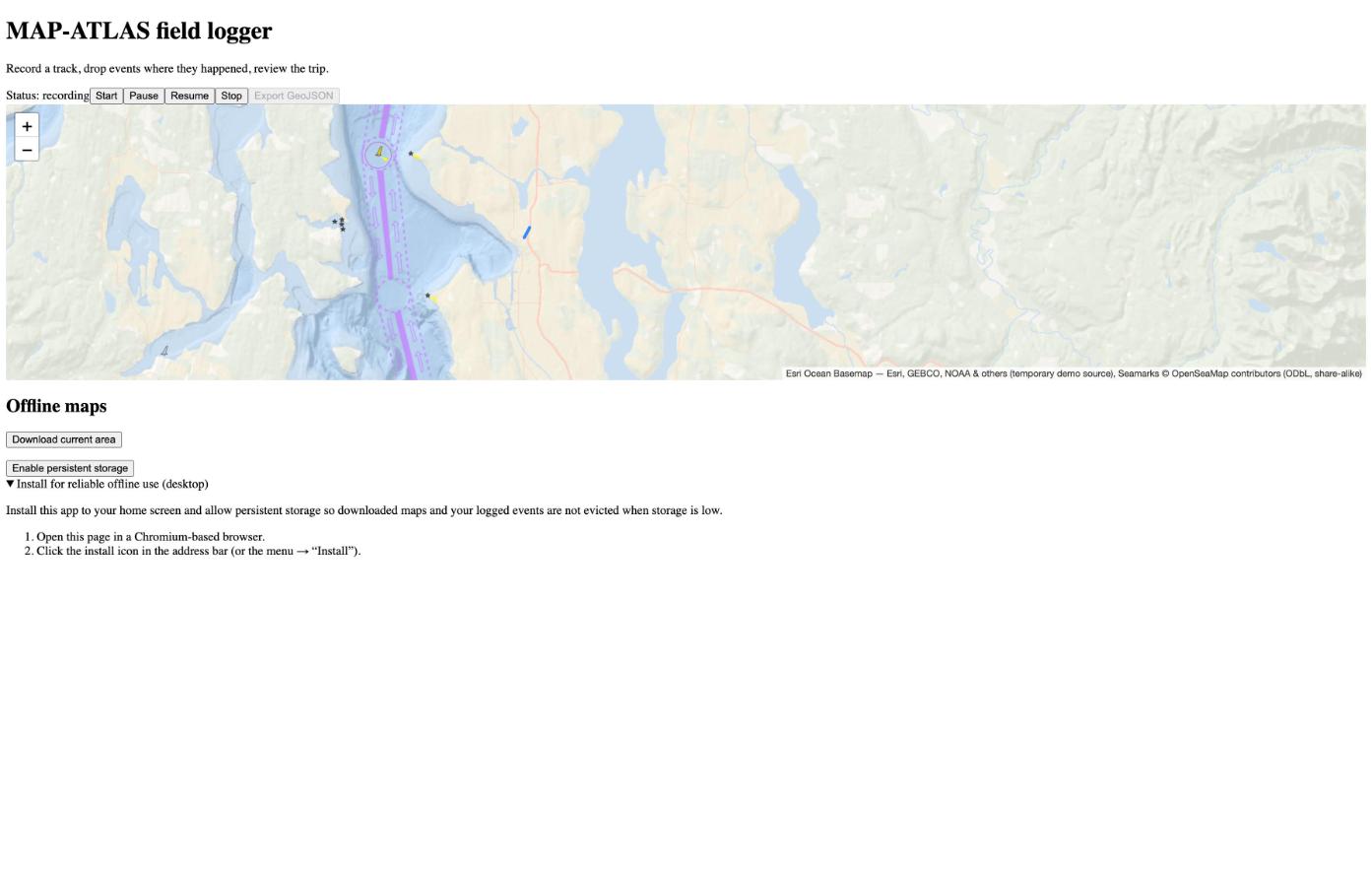
Section titled “What each UI looks like”Claude’s field logger (with review fixes applied — fit-to-track, live track line, crosshair cursor, Esri Ocean bathymetry base + OpenSeaMap seamark overlay):
pi’s field logger (bootstrapped) — a more polished, centered layout with custom fit/locate map controls and a live OSM + OpenSeaMap seamark base:
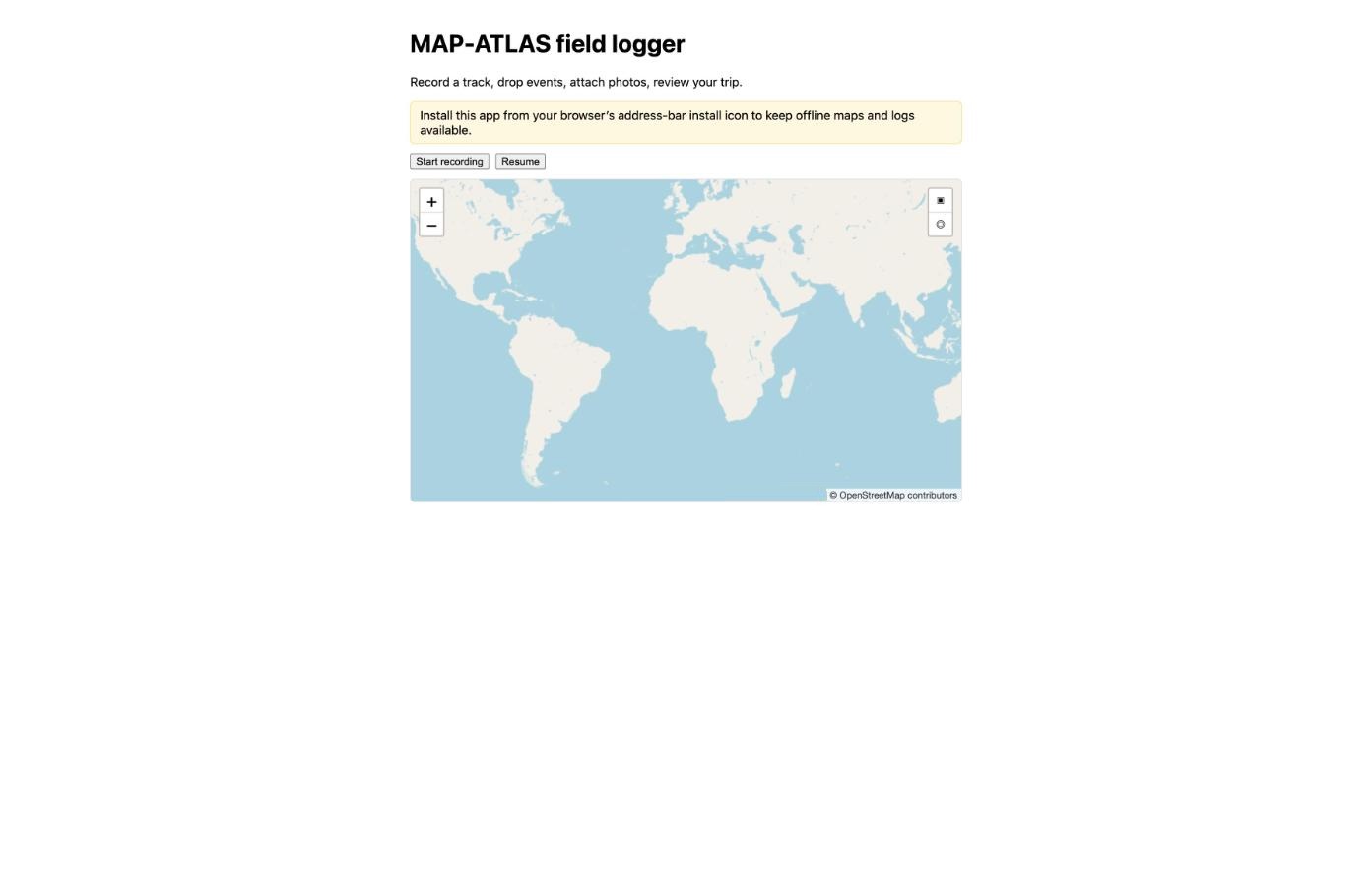
- pi’s UI is the more polished-looking (centered column, custom map controls, real tiles + seamarks out of the box).
- but pi points at public tile hosts (
tile.openstreetmap.org,tiles.openseamap.org), which the spec forbids (§8: “do not point production at public tile hosts”). Claude used the compliant placeholder (grey until tiles are wired). On this detail, Claude was spec-faithful; pi deviated to look good.
Recorder error handling — pi more correct
Section titled “Recorder error handling — pi more correct”The clearest correctness win for pi: geolocation timeouts.
- pi sets
timeout: 30_000onwatchPositionand surfaces the error (“Recorder error: timeout”) — honouring the spec’s"timeout"error kind and giving a field user honest feedback that GPS failed. - Claude sets no timeout →
watchPositionwaits silently forever. It never errors, and its own declared"timeout"error kind is unreachable dead code — a subtle spec-fidelity gap.
The attribution flag
Section titled “The attribution flag”Both demos showed a Ukrainian-flag prefix in the map attribution. That is
Leaflet 1.9’s built-in default attribution prefix (defined in leaflet-src.js),
not anything either harness wrote and unrelated to the map data. The fix — and the
general rule now in ADR-0008 — is engine-owned, neutral, overridable attribution:
the engine sets the prefix explicitly (setPrefix(false)) rather than inheriting a
library default. (The renderer itself is also being moved to MapLibre GL; see
specs/decisions.md ADR-0008 in the MAP-ATLAS repo.)
The UI review reinforces the verdict: Claude ships something you can run that adheres to the spec; pi ships something that looks more finished but skipped the tooling to run it and bent a spec rule to do so — while handling recorder errors more correctly. Neither dominates.
Review changes committed as follow-ups (not part of the scored build): Claude
9722fe0, pi 3211c58 in the MAP-ATLAS repo.
9. Performance & cost
Section titled “9. Performance & cost”Measured from git commit timestamps (the overnight autonomous run), the overnight monitor, and each harness’s own session logs.
Speed per phase (autonomous run, Phases 2–7)
Section titled “Speed per phase (autonomous run, Phases 2–7)”Both harnesses launched ~21:07 and ran continuously; values are inter-commit durations. (Phases 0–1 ran interactively with review/setup gaps and are not speed-comparable.)
| Phase | pi.dev | Claude Code |
|---|---|---|
| 2 · storage-idb | ~6 min | ~7 min |
| 3 · web recorder | 2m 26s | 4m 24s |
| 4 · leaflet renderer | 6m 54s | 6m 21s |
| 5 · react (hooks + 4 components) | 13m 21s | 9m 52s |
| 6 · offline regions | 5m 33s | 6m 49s |
| 7 · demo | 5m 53s | 11m 00s |
| Total (2→7) | ~40 min | ~44 min |
pi finished ~4 minutes sooner (leaner output). Phase 5 (React) was the slowest for both — the most components.
Tokens handled (from each harness’s session logs)
Section titled “Tokens handled (from each harness’s session logs)”| Metric | pi.dev | Claude Code |
|---|---|---|
| Assistant turns | 191 | 565 (≈3×) |
| Output tokens | 183K (63K reasoning) | 826K (≈4.5×) |
| Input (fresh) | 380 | 59K |
| Cache write | 324K | 2.1M |
| Cache read | 13.8M | 74.9M |
| Total tokens | 14.3M | 77.9M (≈5.4×) |
| Cost | $13.50 (metered) | plan-included |
The headline: Claude did ~3× the turns and ~4.5× the output for the same product — a direct, quantified measure of the “thorough vs lean” character difference seen throughout. More tests, ADRs, files, and iteration = more tokens.
Caveats. Total-token counts are dominated by cache reads (which scale with turns × context and are weighted differently from fresh tokens), so output tokens + turns are the fairer “work done” metric. Cost is not directly comparable — pi is metered ($13.50 for the whole build, under the $50 budget); Claude ran plan-included.